Sunday, 17 June 2018

Unit 7- Grammar
There are a number of different ways of referring to the future in English. It is important to remember that we are expressing more than simply the time of the action or event. Obviously, any 'future' tense will always refer to a time 'later than now', but it may also express our attitude to the future event.


Unit 7- Travel
Get away: to go somewhere to have a holiday, often because you need to rest
Get on: If two or more people get on, they like each other and are friends.


Set off: to start a journey

Speed up: to move or happen faster
 Stop over: If a bus, train, etc. stops at a particular place, it lets people get on and off.
Turn back: to move your body so that you are facing a different direction
Take off: f a plane takes off, it begins to fly.


Unit 6- Grammar
Different types of sentences
When you use reported speech, you either report:2. Tenses
- statements
- questions
- requests / commands
- other types
A. Reporting Statements
When transforming statements, check whether you have to change:
- pronouns
- tense
- place and time expression
1- Pronouns
In reported speech, you often have to change the pronoun depending on who says what.Example:
She says, “My dad likes roast chicken.” – She says that her dad likes roast chicken.
| Direct Speech | Reported Speech |
|---|---|
Simple Present
He said: "I am happy" |
Simple Past
He said that he was happy |
Present Progressive
He said: "I'm looking for my keys" |
Past Progressive
He said that he was looking for his keys |
Simple Past
He said: "I visited New York last year" |
Past Perfect Simple
He said that he had visited New York the previous year. |
Present Perfect
He said: " I've lived here for a long time " |
Past Perfect
He said that he had lived there for a long time |
Past Perfect
He said: "They had finished the work when I arrived" |
Past Perfect
He said that they had finished the work when he had arrived" |
Past Progressive
He said: "I was playing football when the accident occurred" |
Past Perfect Progressive
He said that he had been playing football when the accident had occurred |
Present Perfect Progressive
He said:"I have been playing football for two hours." |
Past Perfect Progressive
He said that he had been playing football for two hours |
Past Perfect Progressive
He said: "I had been reading a newspaper when the light went off" |
Past Perfect Progressive
He said that he had been reading a newspaper when the light had gone off |
Future Simple (will+verb)
He said: "I will open the door." |
Conditional (would+verb)
He said that he would open the door. |
Conditional (would+verb)
He said: "I would buy Mercedes if I were rich" |
Conditional (would+verb)
He said that he would buy Mercedes if he had been rich" |
3- Place, demonstratives and time expressions
Place, demonstratives and time expressions change if the context of the reported statement is different from that of the direct speech.
| Direct Speech | Reported Speech |
|---|---|
| Time Expressions | |
| today | that day |
| now | then |
| yesterday | the day before |
| … days ago | … days before |
| last week | the week before |
| next year | the following year |
| tomorrow | the next day / the following day |
| Place | |
| here | there |
| Demonstratives | |
| this | that |
| these | those |
B. Reporting Questions
When transforming questions, check whether you have to change:
Also note that you have to:
- pronouns
- place and time expressions
- tenses
- transform the question into an indirect question
- use the question word (where, when, what, how) or if / whether
C. Reporting requests / commands
When transforming requests and commands, check whether you have to change:
- pronouns
- place and time expressions
Example:
She said, “Sit down." - She asked me to sit down.
She said, "don't be lazy" - She asked me not to be lazyUnit 6- Reporting

Boast: to talk with too much pride
Reply: to answer

Complain: to say that something is wrong or that you are angry about something
Reveal: to tell someone a piece of secret information

Deny: to say that something is not true, or that you have not done something
State: to officially say or write something
Unit 5- Grammar
Review of question forms
Yes/No questions
Yes/No questions
- Is he a teacher? Yes he is.
To form yes/no questions where there is an auxiliary verb or a modal verb, we invert the word order of a positive sentence. (He is a teacher > Is he a teacher?)
- Does she know you. Yes she does.
When there is no auxiliary verb we use ‘do’ to form the question.
With question words
The same rules apply when there is a question word (‘what’, ‘where’, ‘when’, ‘why’, ‘who’, ‘which’, ‘how’, ‘how much’, ‘how many’)
With question words
The same rules apply when there is a question word (‘what’, ‘where’, ‘when’, ‘why’, ‘who’, ‘which’, ‘how’, ‘how much’, ‘how many’)
- Where is the hotel?
Where there is an auxiliary or modal verb, that verb is used to form the question.
- How did you get here?
Where there is no auxiliary verb, we use do.
Subject/Object questions
Sometimes you might see questions like this.
Subject/Object questions
Sometimes you might see questions like this.
- Who broke the window?
- What happened next?
- Who told you that?
There is no auxiliary verb and the word order is not inverted.
These are called subject questions – because the question word is the subject of the sentence.
Look at these two questions.
These are called subject questions – because the question word is the subject of the sentence.
Look at these two questions.
- Who does Romeo love? Romeo loves Juliet.
- Who loves Romeo? Juliet loves Romeo.
In the first question, Romeo is the subject of the verb.
In the second question ‘who’ is the subject and Romeo is the object.
In the second question ‘who’ is the subject and Romeo is the object.

Unit 5- Manners
Appreciation: a feeling of being grateful for something
Consideration: careful thought and attention
Diplomacy: skill in dealing with people well and not upsetting them
Etiquette: the set of rules or customs that control accepted behaviour in particular socialgroups or social situations

 Interaction: an occasion when two or more people or things communicate with or react to each other


Diplomacy: skill in dealing with people well and not upsetting them
Etiquette: the set of rules or customs that control accepted behaviour in particular socialgroups or social situations

 Interaction: an occasion when two or more people or things communicate with or react to each other
Netiquette: the set of rules about behaviour that is acceptable on the internet

Politeness: behaving in a way that is not rude and shows that you think about other people

Rank: a position in society or in an organization
Rudeness: behaving in a way that is not polite and upsets other people

Tradition: a custom or way of behaving that has continued for a long time in a group of people
Wednesday, 2 May 2018
Wednesday, 21 March 2018
Tuesday, 20 March 2018

Grammar Second Term
In Unit 3 we learned the passive voice, we often use the passive when isn't clear or important who does something

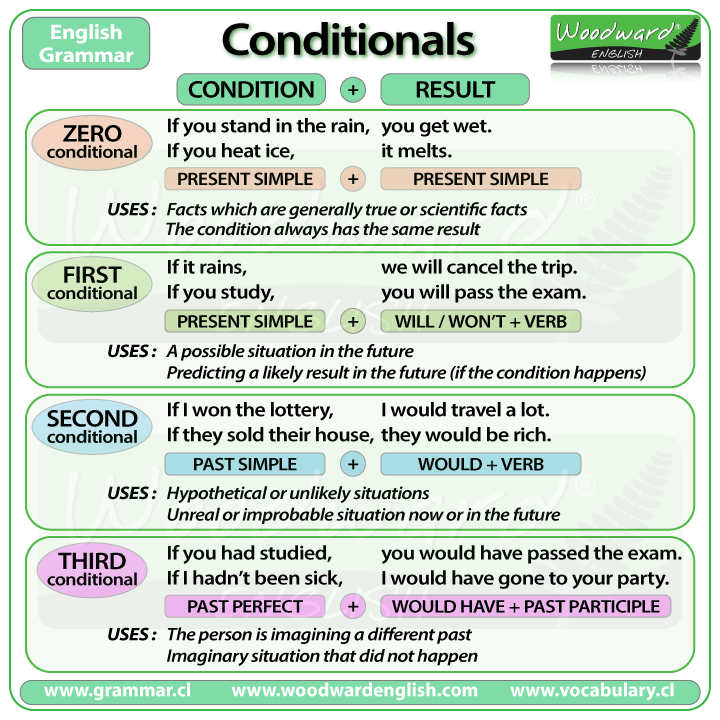
And in Unit 4 we learned the zero, first, second and third conditional.


And in Unit 4 we learned the zero, first, second and third conditional.
Books Vocabulary
The Masque of the Read Death


Bizarre: Strange.
Carefree: Without any problems or worries.
Dare to: Had the courage to do something.
Dizziness: A feeling of head turning round, and loss balance.
Pour: Cause liquid to flow.
Stained glass: Different colored pieces of glass making a pattern.
Took hold of: Took control of.

The Pit and the Pendulum
Choked: Made difficult to breathe.
Choked: Made difficult to breathe.
Craved: Had a strong desire.
Crawled out: Came out slowly.
Faint: Lose consciousness.
Fungus: Plant that feeds on decaying produce.
Gasped: Caught one's breath to show surprise or horror.
Razor: A metal instrument with a sharp edge, used for shaving.
Slippery: Smooth and difficult to walk on.
Tore off: Removed roughly.
Writhed: Twisted and turned in pain.

Second Term Vocabulary
Unit 3
Computer-generated: the process of using computers to create pictures or characters in film and television.
Energy saving: relating to products, systems, etc. that use as little electricity, gas, etc. as possible.
High-tech: using the most advanced and developed machines and methods
Mechanical: operated by a machine, or connected with machines or their parts
Wireless: using a system of radio signals rather than wires to connect computers, mobilephones, etc. to each other.
 An example of computer-generated
Unit 4
Calm down: to stop feeling upset, angry, or excited, or to stop someone feeling this way
Cheer up: If someone cheers up, or something cheers someone up, they start to feel happier
Chill out: to relax completely, or not allow things to upset you
Cut down: to do or use less of something
Face up to: to accept that a difficult situation exists
Open up: to start to talk more about yourself and your feelings
Slow down: to be less active and relax more
Work out: to exercise in order to improve the strength or appearance of your body
Computer-generated: the process of using computers to create pictures or characters in film and television.
Energy saving: relating to products, systems, etc. that use as little electricity, gas, etc. as possible.
High-tech: using the most advanced and developed machines and methods
Mechanical: operated by a machine, or connected with machines or their parts
Wireless: using a system of radio signals rather than wires to connect computers, mobilephones, etc. to each other.
An example of computer-generatedUnit 4
Calm down: to stop feeling upset, angry, or excited, or to stop someone feeling this way
Cheer up: If someone cheers up, or something cheers someone up, they start to feel happier
Chill out: to relax completely, or not allow things to upset you
Cut down: to do or use less of something
Face up to: to accept that a difficult situation exists
Open up: to start to talk more about yourself and your feelings
Slow down: to be less active and relax more
Work out: to exercise in order to improve the strength or appearance of your body
Sunday, 17 December 2017
First Term Self-Assessment
- What can I do that I couldn't do before?
- What did I like most?
- What did I do well?
- What am I confused about?
- What did I do in English outside the class?
- What do I need to improve?
- What did I learn about culture?
- I think that I have to force in general, but this year it's more difficult than last year, because we have to do a lot of thing of the different subjects.
- The activity that I like a lot it's the projects that we do, por example the video o talk about a theme or something like that, I think that improves our English because we talk with more fluency and make the lesson more pleasant too.
- I think that the work that I do well is the speaking, I think that I speak more than the last years, and I have more fluency and i have less embarrassment.
- I am confused about the result of my exams, because I study a lot and I don't have the result that I think deserved.
- I read some book in English and I see films in English and other languages
- I think to improve i have to speak more in class and participate. And change my method of study.
- I learn about thanksgiving because I had heard about them but I didn't now the meaning until the Michael' class, new slogan about publicity too and also phonetic, the differents sounds.
Unit 2
VOCABULARY
Advertise: to make something known generally or in public, especially in order to sell it.
Appeal: a request to the public for money, information, or help
Appear: to start to be seen or to be present
Broadcast:to send out a programme on television or radio
Claim: to say that something is true or is a fact, although you cannot prove it and other people might not believe it
Bargain: something on sale at a lower price than its true value
Bid: o offer a particular amount of money for something that is for sale and compete against other people to buy it, especially at a public sale of goods or property.
Purchase: to buy something
Refund: an amount of money that is given back to you, especially because you are not happy with a product or service that you have bought
Supply: to provide something that is wanted or needed, often in large quantities and over a long period of time
Supplier: a company, person, etc. that provides things that people want or need, especially over a long period of time

Advertise: to make something known generally or in public, especially in order to sell it.
Appeal: a request to the public for money, information, or help
Appear: to start to be seen or to be present
Broadcast:to send out a programme on television or radio
Claim: to say that something is true or is a fact, although you cannot prove it and other people might not believe it
Bargain: something on sale at a lower price than its true value
Bid: o offer a particular amount of money for something that is for sale and compete against other people to buy it, especially at a public sale of goods or property.
Purchase: to buy something
Refund: an amount of money that is given back to you, especially because you are not happy with a product or service that you have bought
Supply: to provide something that is wanted or needed, often in large quantities and over a long period of time
Supplier: a company, person, etc. that provides things that people want or need, especially over a long period of time

Wednesday, 22 November 2017
Vocabulary and expressions Unit 0-1
Vocabulary of technology:
Browse: Navegar
Stream: Corriente
Update: Actualizar
Scroll: Deslizar de arriba a abajo
Swipe: Desplazar de derecha a izquierda
Vocabulary about adjetives: Other adjetives of personality:
Efficient/ inefficient: Eficaz/ineficaz Warm: Cariñoso
Reliable/ unreliable: fiable/de poca confianza Pleasant: Agradable
Useful/ useless : Útil/ Inútil Cold: Distante
Unpleasant: Desagradable
Vocabulary about sports: Reserved: Apartado
Kayaking: Piraguismo Easy-going: Relajada
Trail biking: Gloomy: Melancólico
Wakeboard: tabla de ski acuático Caring: Empático
Tactless: Insensible
Vocabulary about preposition: Liar: Mentiroso
Try out: Probar Flexible: Adaptable
Catch up: Alcanzar Open-minded: De mentalidad abierta
Pick up: Recoger Narrow-minded: De mentalidad cerrada
Take up: Comenzar
Miss out: Omitir
Vocabulary of Unit 1
Supportive: Giving help or encouragement
Truthful: Honest person
Dependable: That you can trust
Sympathetic:Showing that you understand people feelings
Eager: Really wanting to do something
Browse: Navegar
Stream: Corriente
Update: Actualizar
Scroll: Deslizar de arriba a abajo
Swipe: Desplazar de derecha a izquierda
Vocabulary about adjetives: Other adjetives of personality:
Efficient/ inefficient: Eficaz/ineficaz Warm: Cariñoso
Reliable/ unreliable: fiable/de poca confianza Pleasant: Agradable
Useful/ useless : Útil/ Inútil Cold: Distante
Unpleasant: Desagradable
Vocabulary about sports: Reserved: Apartado
Kayaking: Piraguismo Easy-going: Relajada
Trail biking: Gloomy: Melancólico
Wakeboard: tabla de ski acuático Caring: Empático
Tactless: Insensible
Vocabulary about preposition: Liar: Mentiroso
Try out: Probar Flexible: Adaptable
Catch up: Alcanzar Open-minded: De mentalidad abierta
Pick up: Recoger Narrow-minded: De mentalidad cerrada
Take up: Comenzar
Miss out: Omitir
Vocabulary of Unit 1
Supportive: Giving help or encouragement
Truthful: Honest person
Dependable: That you can trust
Sympathetic:Showing that you understand people feelings
Eager: Really wanting to do something
Monday, 2 October 2017
Back to shcool!!

Here we are again!!
In the last course of the E.S.O, I hope that this last year is one of the best to remember with the end-of-year trip and the graduation.
Saturday, 3 June 2017
ENGLISH AND GEOGRAPHY PROJECT
Bretonianadvisor. Imperial Cities Tour:
Budapest (Hungary), Bratislava (Slovakia) and Praga (Zhech Republic)
3RD TERM PROJECT: IMPERIAL CITIES
Budapest (Hungary), Bratislava (Slovakia) and Praga (Zhech Republic)
3RD TERM PROJECT: IMPERIAL CITIES
Monday, 24 April 2017
HOW CAN I BE MORE ENVIRONMENTALLY FRIENDLY?
1.Stop using bottled water
2.Stop smoking. Smoking creates pollution inside of your body and for the people around you.
3.Use less electricity.
4.less gas
5.Recycle.
6.Use reusable shopping bags
7.Save water
This is the list that I think we can do to be environmentaly friendly
2.Stop smoking. Smoking creates pollution inside of your body and for the people around you.
3.Use less electricity.
4.less gas
5.Recycle.
6.Use reusable shopping bags
7.Save water
This is the list that I think we can do to be environmentaly friendly
Subscribe to:
Posts (Atom)