
Showing posts with label Grammar. Show all posts
Showing posts with label Grammar. Show all posts
Sunday, 17 June 2018
Unit 7- Grammar
There are a number of different ways of referring to the future in English. It is important to remember that we are expressing more than simply the time of the action or event. Obviously, any 'future' tense will always refer to a time 'later than now', but it may also express our attitude to the future event.


Unit 6- Grammar
Different types of sentences
When you use reported speech, you either report:2. Tenses
- statements
- questions
- requests / commands
- other types
A. Reporting Statements
When transforming statements, check whether you have to change:
- pronouns
- tense
- place and time expression
1- Pronouns
In reported speech, you often have to change the pronoun depending on who says what.Example:
She says, “My dad likes roast chicken.” – She says that her dad likes roast chicken.
| Direct Speech | Reported Speech |
|---|---|
Simple Present
He said: "I am happy" |
Simple Past
He said that he was happy |
Present Progressive
He said: "I'm looking for my keys" |
Past Progressive
He said that he was looking for his keys |
Simple Past
He said: "I visited New York last year" |
Past Perfect Simple
He said that he had visited New York the previous year. |
Present Perfect
He said: " I've lived here for a long time " |
Past Perfect
He said that he had lived there for a long time |
Past Perfect
He said: "They had finished the work when I arrived" |
Past Perfect
He said that they had finished the work when he had arrived" |
Past Progressive
He said: "I was playing football when the accident occurred" |
Past Perfect Progressive
He said that he had been playing football when the accident had occurred |
Present Perfect Progressive
He said:"I have been playing football for two hours." |
Past Perfect Progressive
He said that he had been playing football for two hours |
Past Perfect Progressive
He said: "I had been reading a newspaper when the light went off" |
Past Perfect Progressive
He said that he had been reading a newspaper when the light had gone off |
Future Simple (will+verb)
He said: "I will open the door." |
Conditional (would+verb)
He said that he would open the door. |
Conditional (would+verb)
He said: "I would buy Mercedes if I were rich" |
Conditional (would+verb)
He said that he would buy Mercedes if he had been rich" |
3- Place, demonstratives and time expressions
Place, demonstratives and time expressions change if the context of the reported statement is different from that of the direct speech.
| Direct Speech | Reported Speech |
|---|---|
| Time Expressions | |
| today | that day |
| now | then |
| yesterday | the day before |
| … days ago | … days before |
| last week | the week before |
| next year | the following year |
| tomorrow | the next day / the following day |
| Place | |
| here | there |
| Demonstratives | |
| this | that |
| these | those |
B. Reporting Questions
When transforming questions, check whether you have to change:
Also note that you have to:
- pronouns
- place and time expressions
- tenses
- transform the question into an indirect question
- use the question word (where, when, what, how) or if / whether
C. Reporting requests / commands
When transforming requests and commands, check whether you have to change:
- pronouns
- place and time expressions
Example:
She said, “Sit down." - She asked me to sit down.
She said, "don't be lazy" - She asked me not to be lazyUnit 5- Grammar
Review of question forms
Yes/No questions
Yes/No questions
- Is he a teacher? Yes he is.
To form yes/no questions where there is an auxiliary verb or a modal verb, we invert the word order of a positive sentence. (He is a teacher > Is he a teacher?)
- Does she know you. Yes she does.
When there is no auxiliary verb we use ‘do’ to form the question.
With question words
The same rules apply when there is a question word (‘what’, ‘where’, ‘when’, ‘why’, ‘who’, ‘which’, ‘how’, ‘how much’, ‘how many’)
With question words
The same rules apply when there is a question word (‘what’, ‘where’, ‘when’, ‘why’, ‘who’, ‘which’, ‘how’, ‘how much’, ‘how many’)
- Where is the hotel?
Where there is an auxiliary or modal verb, that verb is used to form the question.
- How did you get here?
Where there is no auxiliary verb, we use do.
Subject/Object questions
Sometimes you might see questions like this.
Subject/Object questions
Sometimes you might see questions like this.
- Who broke the window?
- What happened next?
- Who told you that?
There is no auxiliary verb and the word order is not inverted.
These are called subject questions – because the question word is the subject of the sentence.
Look at these two questions.
These are called subject questions – because the question word is the subject of the sentence.
Look at these two questions.
- Who does Romeo love? Romeo loves Juliet.
- Who loves Romeo? Juliet loves Romeo.
In the first question, Romeo is the subject of the verb.
In the second question ‘who’ is the subject and Romeo is the object.
In the second question ‘who’ is the subject and Romeo is the object.

Tuesday, 20 March 2018
Grammar Second Term
In Unit 3 we learned the passive voice, we often use the passive when isn't clear or important who does something

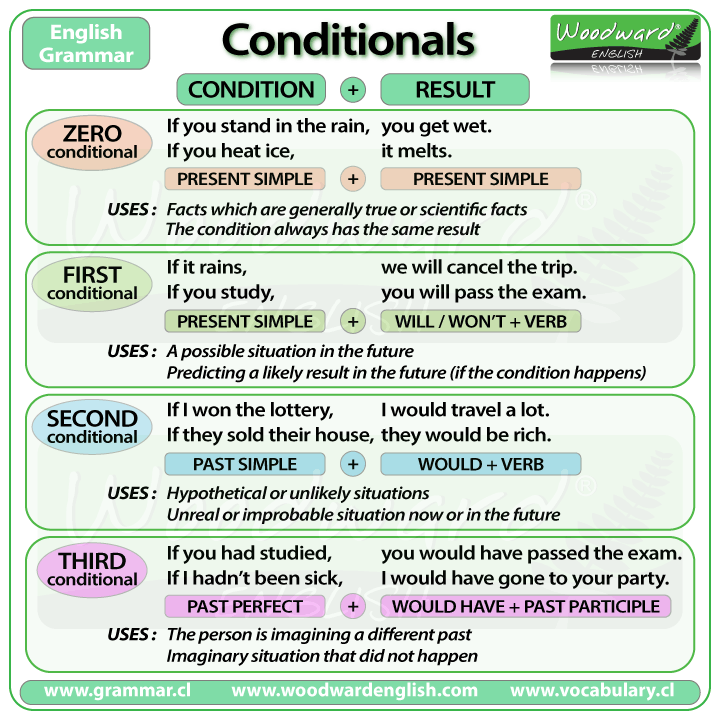
And in Unit 4 we learned the zero, first, second and third conditional.


And in Unit 4 we learned the zero, first, second and third conditional.
Subscribe to:
Posts (Atom)